|
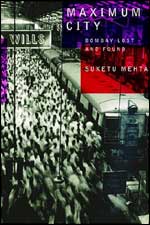
Q&A with Suketu Mehta from the Wall Street Journal Europe Time Off — Backstage: Suketu Mehta How can you do business with a man by day and set him on fire at night? How can you make room for an unknown runaway, when your home is the pavement? How can you weep over a bar dancer yet think nothing of putting a bullet through her head if that’s your job? These are the paradoxes that run through Suketu Mehta’s first book, the nonfiction Maximum City: Bombay Lost and Found. For Bombay, Indian megacity of riches and dreams, home to 14 million people living in high-rises subsumed by slums, is the fascinating Mistress of Extremity, and Mr. Mehta, her masterly interpreter. At the book’s recent world launch in Bombay, the 41-year-old author read aloud his documentary-like prose. In one haunting passage, his words were a movie camera, rolling over the sexy Mona Lisa, a dancer to Bollywood film songs at a bar full of crooks and businessmen who shower her with currency. But it was the stillness in the room when Mr. Mehta’s voice lightly touched upon the scars on her wrists, that went home with the audience. After the event, the New York-based Mr. Mehta spoke with Sangita P. Advani at length about his seven-year obsession with the city of his childhood. And it emerged that in Mr. Mehta’s nonjudgmental exposition of untold lives, Mona Lisa’s smile became art. Q: What prompted you to write Maximum City: Bombay Lost and Found? A: I wrote the book because I wanted to find out if I could go home again. After 21 years abroad, I came back to Bombay with my wife and two children and I found home through the story of its inhabitants, often in the most marginalized parts of the city. They trusted me. After 2 1/2 years, I discovered that not only can you go home again, you can also leave again, go once more with confidence, into the world. Q: Did you find home? A: When I was 14, I had to leave Bombay to move to the U.S. To understand this central event in my life, I became a writer. This fact of migration is constantly there in the book; it’s there in Naipaul’s writing, in Rushdie’s as well. But home for us is not a geographically intact entity. I have a living room in New York, a bedroom in Paris, a bedroom in London. In all these places I have a collection of friends and family that make it home. I can live in any of these places, with a similar set of rituals, like seeing a really good French film in the evening, drinking some good wine and savoring a pasta. And I can do this in Bombay, or Paris or Lahore. Q: Yet you find home, not among Bombay’s pasta-eaters, but among hitmen, Bollywood filmmakers, bar girls and pavement dwellers. How did you deal with the fact that some of your new friends were criminals? A: It was very scary and continues to be so. But I wasn’t interested in making judgments because then I would be judging my own life. I would hope that they will find that I’ve been fair to them, presenting them as fully rounded humans. . . . I don’t spare myself. I’ve changed the names of most — probably they won’t be identified — but there’s potential for really serious violence, or lawsuits. It’s a great risk one takes in writing nonfiction. . . . As the famed Czech poet Jaroslav Seifert said, for anybody else, not telling the truth can be a tactical maneuver. But for the writer, staying silent is lying. So, if I write about these people without their darker side, then . . . I might as well be writing propaganda. Q: Your book reveals one aspect of Bombay as a cosmopolitan city of coexistence, where commerce is God. You also show its darker side, in the aftermath of the 1993 communal riots. Is there an explanation? A: Megacities like Bombay witness periodic explosions, when unimaginable pressures need an outlet. The other thing that the riots do is that they throw up a whole new class into petty political power. So, I followed the career of Sunil, a slum-dweller-turned-political thug, before and after the riots. During the riots, he killed Muslims. By day, he would also trade with the same people. After the riots he became a special executive officer, wielding what he calls “powertoni,” a contraction of “power of attorney.” So there was a whole class of such people. Now he is a pretty successful entrepreneur, who doesn’t want riots because he has a stake in economic stability. Q: Are you saying that it’s a good thing that we have criminals in politics? A: When you talk of criminality in Indian politics — it’s not a good or bad thing, it’s a process. There’s an entire generation of troublemakers who need a riot in order to ascend the political ranks that Sunil’s at. . . . So, a riot is a shortcut to political power for the disenfranchised. You will find the same thing in American cities in the late 19th and early 20th centuries. The gangster gets elected for a reason. Q: How would you compare elections in the world’s two largest democracies, the U.S. and India? A: In India, the poor vote. I have just come from America where there’s a farce of an election taking place, where the people who are most directly affected by Bush’s policies are too beaten down to register and vote. This is not true in India. The unexpected return to power of the Congress party, in the recent national elections in India, wasn’t a revolt of the village against the city. It wasn’t even about secularism. It was that the “India Shining” campaign by the incumbent nationalist Hindu party, the BJP, was seen as a sham. It was the revolt of the poor against the rich. Q: How do you rationalize the mind-boggling paradoxes thrown up by Bombay? A: One has to go back to Indian philosophy, to the . . . Jain science of “maybeness.” . . . We have this ability which serves us well and ill, to be individually multiple. Looking at Sunil, the rioter, or Ajay Lal, the policeman who was beating up suspects, but had a certain sense of mission — he was doing his dharma — I saw that who we are and how humane or not we are just depends on the particular condition. For us, morality and ethics, like comedy, is a situation. Q: Whom does your book address?
A: I think there is a global hunger for learning about megacities, Bombay in particular. People know it’s special but they don’t know how so. I’m hoping that this book will be as much of a revelation to Bombayites as it is to others. I like to think that it reads like a good novel rather than urban history. It’s a group of interrelated stories and what’s links them all is my own story and my quest to go home again. Q: Why do you leave Bombay feeling optimistic? A: It’s to the credit of this city. Any city where people are still coming in large numbers is not a dying city. — Maximum City: Bombay Lost and Found has just been released in India, Europe and the U.S. Mr. Mehta is now working on a novel, as well as a screenplay, “The Goddess,” for Merchant-Ivory Productions, to star Tina Turner. |
Other reviews |
|